
Created by Daniela Ezequiel at Monday, 27 July 2026
Smart #2 testing continues before its October debut in Paris
The new Smart #2 has already entered the final stage of its global testing program, moving ever closer to its world debut, scheduled for October 2026 at the Paris Motor Show. Fully electric, compact, and designed for two people, the model aims to recover the spirit of the well-known Smart Fortwo, adapting it to today’s demands of urban mobility.
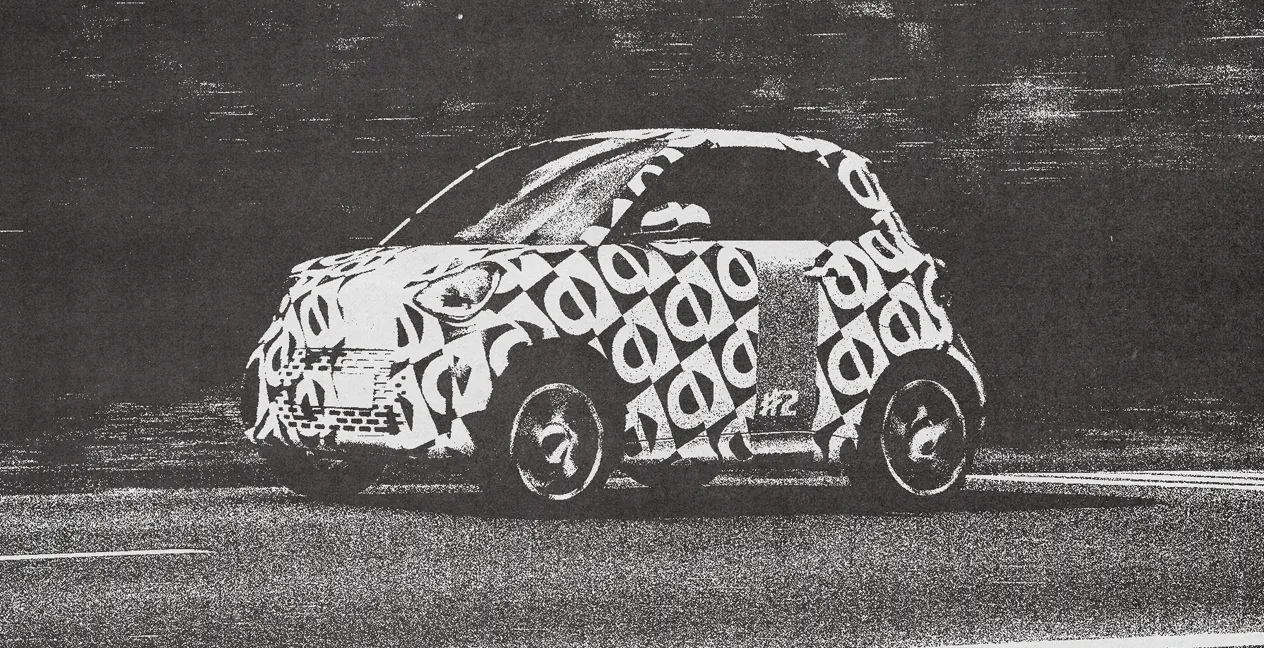
After first presenting the model in Beijing, Smart released new images of the functional prototype, still wearing camouflage bodywork. Although the final details remain hidden, it is already possible to see that the Smart #2 will maintain a compact silhouette, with the wheels positioned near the extremities of the body.
This configuration, which has accompanied the model since the first generation, makes better use of interior space and makes manoeuvring easier in narrow streets, car parks, and other more demanding urban environments.
Tests focused on safety, comfort, and agility
Before its official presentation, the new Smart #2 is being subjected to an extensive validation program. The goal is to ensure that the electric city car offers safe, comfortable, and predictable behaviour in everyday urban situations.
During testing, the car faced unexpected obstacles, rapid lane changes, wet roads, and low-grip surfaces. Engineers are also working on tuning the steering, suspension, and different chassis mounting points, seeking to achieve a balance between stability and agility.
Acoustic comfort is another aspect receiving special attention. Tests were carried out in wind tunnels, acoustic chambers, test benches, closed tracks, and public roads. These trials make it possible to assess noise caused by the tyres, vehicle vibrations, and any sounds coming from components inside the cabin.
The Smart #2 was also tested on rough asphalt, grooved concrete, degraded roads, continuous undulations, and streets with potholes. More demanding situations were also simulated, such as mounting kerbs or hitting larger potholes.
The choice of tyres is also being studied in detail. The brand aims to reduce rolling resistance, contributing to greater range, without compromising comfort and the level of noise felt inside the cabin.
In terms of occupant protection, the new model will feature an evolution of the well-known tridion safety cell. This structure was developed to meet current safety requirements and reinforce the car’s stability and strength.
An interior designed for cities
The Smart #2 will keep a two-seat layout, but the interior presents some unusual solutions. Between the two seats there will be a foldable central section, which may function as an armrest or transform into a continuous surface.
This solution aims to create a greater feeling of space in the cabin and make it easier for occupants to exit through the opposite door. A feature that may be particularly useful when the car is parked in a tight space and there is not enough room to open one of the doors.
The window controls and door lock switches will be integrated into this movable area, which will also include a handle to make its use easier.
The dashboard will feature a curved S-shaped design, accompanied by air vents inspired by the visual language of some Mercedes-Benz models. Although it uses digital interfaces, Smart intends to avoid a cabin dominated by large screens.
On the outside, the released images show an evolution of the traditional Fortwo shape, adapted to the brand’s current visual identity. At the front, the headlights and grille show some similarities with the previous Smart EQ Fortwo. At the rear, two round taillights stand out, similar to those presented on the Smart Concept #2.
Up to 300 kilometres of range
Unlike previous generations, which used platforms prepared for different types of powertrain, the new Smart #2 was developed from the outset as a fully electric car.
According to information reported by the specialist press, the model is expected to feature a 35.7 kWh battery and offer a range close to 300 kilometres, according to the WLTP cycle.
Charging from 10 to 80 percent may take less than 20 minutes, making it possible to recover a significant part of the range during a relatively short stop. These figures should still be officially confirmed by the brand during the model’s presentation.
Another technical highlight is the independent multi-link rear suspension. This is an unusual solution in a car of this segment and may contribute to improving comfort, stability, and road behaviour.
The world debut of the new Smart #2 is scheduled for October 2026 during the Paris Motor Show. Sales are expected to begin in 2027, with the model planned to be produced in China.
With compact dimensions, electric power, and solutions designed specifically for daily use in cities, the Smart #2 is preparing to recover a space that for many years was associated with the Fortwo. Its big mission will be to show that a two-seat city car still makes sense at a time when cities are looking for more efficient, agile, and easy-to-park vehicles.
Sources: Guia do Automóvel, Turbo, Motor1