
Created by Daniela Ezequiel at Tuesday, 21 July 2026
Last Bugatti W16 Mistral closes a two-decade era
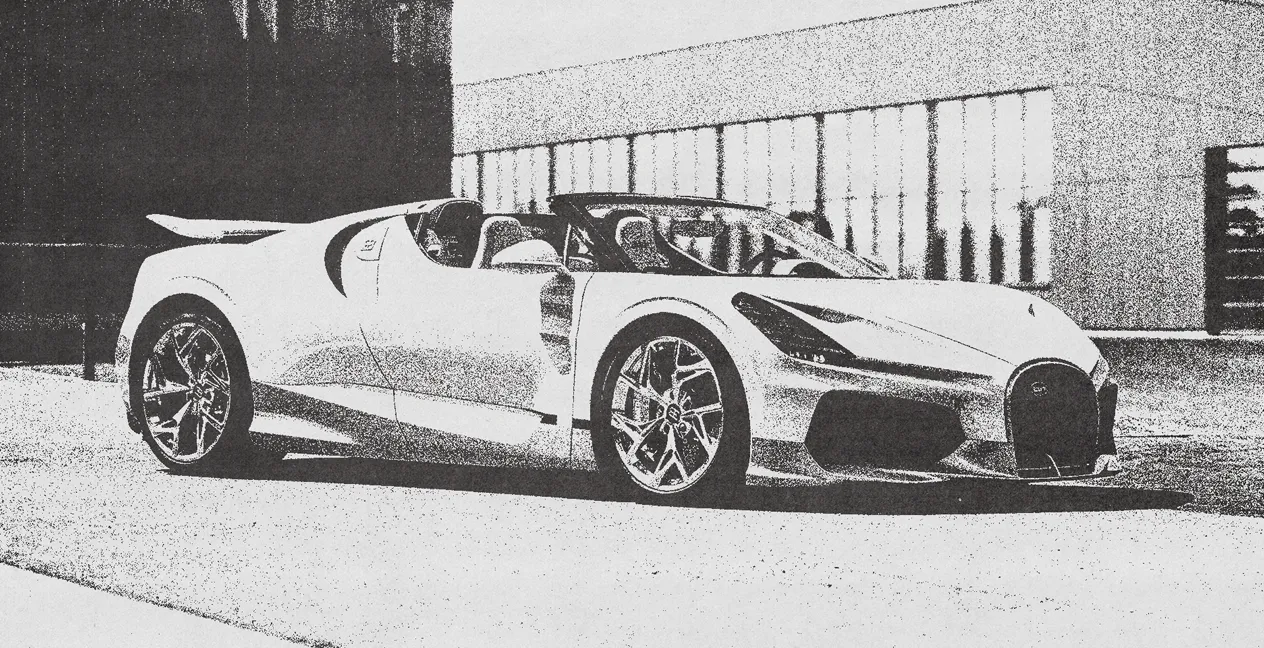
Bugatti has completed production of the final W16 Mistral, bringing one of the most remarkable eras in recent automotive history to an end. With this example leaving the Atelier in Molsheim, the use of the legendary W16 engine in the French brand’s production models officially comes to a close.
It was two decades of power, speed, and figures that are hard to imagine. Introduced in the Bugatti Veyron in 2005, the 8.0-litre W16 engine with four turbochargers redefined what was expected from a road car. Later, it continued to evolve in the Chiron and in the various special versions developed from this hypercar.
The Bugatti W16 Mistral was entrusted with the farewell. Presented in August 2022 and limited to just 99 units, it became the last catalogue model homologated for road use equipped with this powertrain.
A truly unique final Mistral
The example that closes production was developed through the Bugatti Sur Mesure personalization programme. The body combines two distinct finishes, Pearl and Gloss, while the open two-seat cabin features leather in Magnolia and Matte Carbon Grey tones.
Among the exclusive details is an aluminium falcon head, created to honour the owner’s roots in the Middle East. The same motif appears embroidered on the door panels, reinforcing the personalized character of this final automobile.
The armrest also includes a frozen crystal piece developed in partnership with Lalique, the well-known French crystal manufacturer. Ettore Bugatti’s signature appears on the engine cover, the headrests, and the machined aluminium door sills.
A commemorative plaque completes the configuration, identifying this W16 Mistral as the last representative of its kind.
Beneath the bodywork lies the most powerful version of the W16 engine. The 8.0-litre unit develops 1600 hp and 1600 Nm of torque, figures identical to those of the Bugatti Bolide, created exclusively for track use.
All this power allows the Mistral to accelerate from 0 to 100 km/h in around 2.5 seconds and to exceed 300 km/h in approximately 12 seconds.
Top speed is limited to 380 km/h in normal mode. With the specific high-speed configuration, it can reach 420 km/h. However, the model has already shown that it is capable of going even further.
In 2024, driver Andy Wallace reached 453.9 km/h on a test track in Papenburg, Germany. The result allowed the Bugatti W16 Mistral to set a new world speed record for a production convertible.
More than the numbers, the W16 has always stood out for the way it delivered its power. The four turbochargers come into operation progressively, creating intense and almost continuous acceleration.
The first two turbochargers begin to operate at lower revs. From around 3000 rpm, the remaining ones come into action, providing an even stronger response.
In the Mistral, this experience is accompanied by the sound of the engine and the proximity of the air intakes, placed immediately behind the occupants. The W16 can draw in up to around 70,000 litres of air per minute, contributing to a sound experience that is difficult to reproduce in any other car.
Extreme performance without giving up comfort
Despite its performance figures, the Bugatti W16 Mistral was not developed solely to achieve impressive speeds. The model seeks to combine the capability of a hypercar with the comfort and refinement expected of a Bugatti.
The seats offer supportive comfort, while still maintaining a high level of refinement. The suspension is also able to cope with less-than-perfect surfaces, even when the sportiest driving mode is selected.
In Top Speed mode, ground clearance is reduced to 80 millimetres at the front and 89 millimetres at the rear. Even so, the Mistral does not become an excessively rigid or difficult car to use.
The interior also avoids the excessive use of large screens. The centre console features a metallic structure with four circular controls, prioritizing materials, mechanical details, and a more timeless approach.
Naturally, all this exclusivity comes at a price. The Bugatti W16 Mistral exceeded five million euros before the inclusion of options and customization. Even so, all 99 units were sold before production was completed.
The end of Mistral production does not, however, mean that the W16 engine will disappear immediately from Molsheim. Bugatti may continue to use some existing platforms and engines in special projects developed through the Programme Solitaire.
This programme has already given rise to exclusive models such as the Brouillard and the Veyron FKP Hommage, both based on the Chiron’s technical architecture. Even so, the W16 Mistral represents the true end of this engine in regular production models.
Bugatti is now preparing a new phase with the Tourbillon. The Chiron’s successor replaces the quad-turbo W16 engine with a new naturally aspirated V16 combined with a hybrid system.
It will be a profound change, but one aligned with the brand’s tradition of seeking technical solutions unlike anything else on the market.
The final Bugatti W16 Mistral therefore closes a two-decade era marked by records, extreme engineering, and some of the fastest cars ever produced. Bugatti’s future will be different, but the impact of the W16 on automotive history is unlikely to be forgotten.
Sources: Turbo, Razão Automóvel