
Created by Cynthia Batista at Wednesday, 22 April 2026
Bertha Benz: the bold journey that proved the car's value
When talking about the history of the automobile, Karl Benz is almost always the first name to come up. After all, he was the man who developed what is widely recognised as the first car in history. But there is another figure who was absolutely decisive in this chapter of mobility and who remained in the background for far too long: Bertha Benz.
More than the inventor’s wife, Bertha was a true pioneer. And not only because she became the first person to complete a long-distance journey by car. She was also someone with the vision, courage and practical mindset needed to prove to the world that this strange three-wheeled vehicle could have real everyday use.
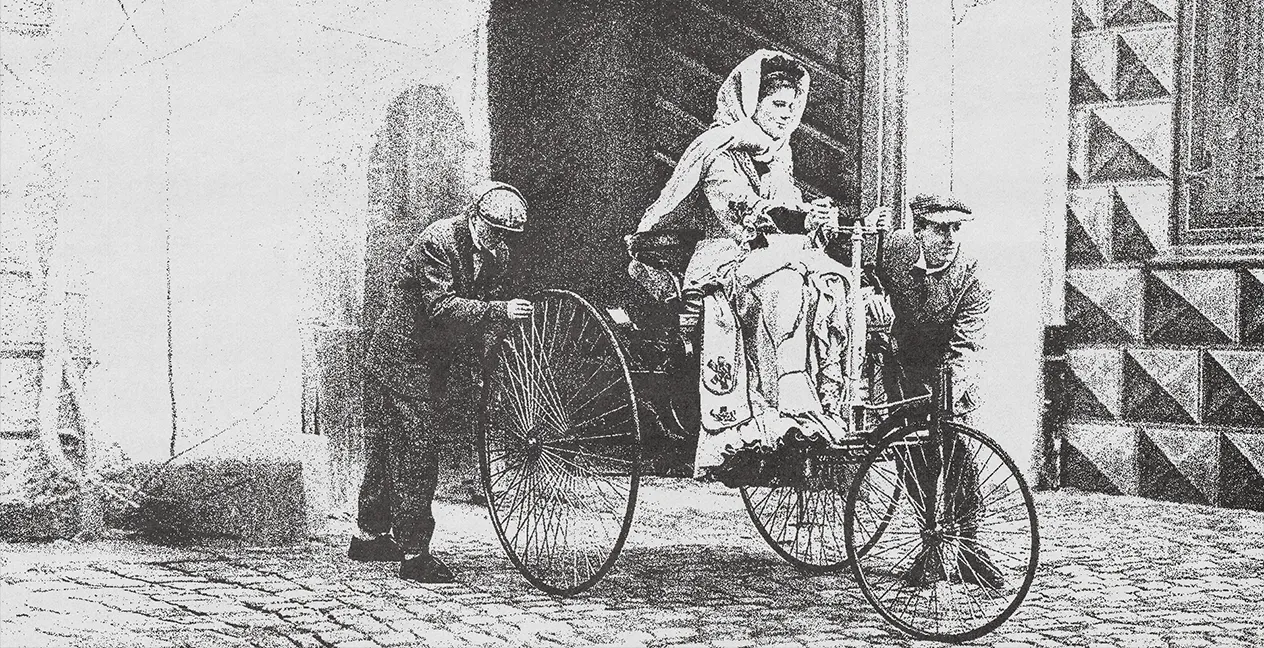
In August 1888, without telling her husband, Bertha Benz set off from Mannheim to Pforzheim, accompanied by her two sons, Eugen and Richard. Her goal was clear: to prove that the Benz Patent-Motorwagen was not just an engineering experiment, but an invention capable of working in the real world. The trip covered around 106 kilometres and became one of the most important moments in automotive history.
A journey far ahead of its time
Today, it may sound like a simple gesture. At the time, it was anything but. There were no proper roads, no fuel stations, no workshops and no kind of support along the way. The automobile was still viewed with suspicion and, to many people, it was nothing more than a mechanical curiosity with no real future. Bertha saw it differently.
Throughout the journey, several problems arose, and that was precisely when her role became even more remarkable. Faced with mechanical issues, Bertha had to improvise solutions. There are records that she used a hat pin to unclog the fuel line and a garter as insulating material. The brake linings, worn down by the descents, were also reinforced by a shoemaker. All of this shows that this was not just a symbolic trip. It was a true test of endurance, ingenuity and determination.
Refuelling was also a challenge. Since fuel stations did not exist, Bertha bought ligroin from a pharmacy in Wiesloch. That moment went down in history as the first automobile refuelling stop and turned that location into a kind of first service station in the world. Along the way, there were also uphill sections where her sons had to push the vehicle and moments when the engine needed to be cooled with water.
The moment that helped change the automobile forever
But the most important part happened beyond the difficulties. Bertha managed to reach her destination and, a few days later, returned to Mannheim. The journey showed that the automobile could be reliable, practical and useful. Suddenly, what many people had seen as an extravagance began to be viewed in a very different way. The impact was immediate. The Benz name gained visibility, public attention increased and the invention began to be taken much more seriously.
That is why this journey should not be seen merely as a historical curiosity. In practice, it was one of the first major public demonstrations of the automobile’s value. If Karl Benz was the inventor, Bertha Benz was, in a way, the car’s first great ambassador. She was the one who helped introduce this new form of mobility to the world and prove that it had a future.
More than a century later, her story remains striking. Not only because of the technical achievement, but also because of its symbolism. Bertha Benz showed that automotive progress does not depend only on those who invent, but also on those who believe, take risks and make the next move. Her journey helped pave the way for everything that came after.
In an industry that is constantly evolving, looking back and remembering figures like Bertha Benz is also a way of understanding that the automobile has always been built on innovation, but also on boldness. And few examples illustrate that better than the woman who, in 1888, decided to take a vehicle that still seemed strange for its time and prove that the future really could move on wheels.
Sources: Mercedes-Benz, Britannica, Razão Automóvel, Ekonomista.