
Created by Tiago Fernandes at Tuesday, 11 August 2026
AC vs DC Charging: What's the Difference?
Anyone who drives or is considering buying an electric car will, sooner or later, come across two terms associated with charging: AC and DC.
Both refer to the type of electric current used during charging, but they work differently. This difference helps explain why an electric car may charge at a certain power level at home but reach much higher figures when connected to a fast charger.
Understanding the differences between AC and DC charging makes it easier to choose the most suitable charging point, understand the limits of the vehicle itself and see why a more powerful charger does not always mean faster charging.
But first, let's start with the basics.
What do AC and DC mean?
AC stands for Alternating Current, while DC stands for Direct Current.
The electricity normally supplied to our homes and businesses through the power grid is alternating current. However, the traction battery in an electric vehicle stores energy as direct current. Therefore, when the vehicle receives AC power, it must be converted into DC before it can be stored in the battery.
It is precisely where this conversion takes place that defines one of the main differences between the two types of charging.
With AC charging, the current is converted by the vehicle's own onboard charger.
With DC charging, the conversion is carried out by the charging equipment. The electricity is therefore supplied to the vehicle as direct current, without depending on the AC-to-DC conversion capacity of the onboard charger.
How does AC charging work?
AC charging is very common at home, in the workplace, in car parks and at many public charging points.
When the vehicle is connected to an AC charging point, it receives alternating current. The vehicle's onboard charger then converts this electricity into direct current so that it can be stored in the battery.
This is why charging speed does not depend solely on how much power the charging point can provide.
Imagine an electric car whose onboard charger can accept a maximum of 11 kW AC. Even if it is connected to a wallbox or charging point capable of supplying 22 kW, the vehicle will still be limited to the 11 kW its AC charging system can accept.
According to E-REDES, wallboxes installed in private locations can provide between 3.7 kW and 22 kW. Public normal charging points also commonly provide between 3.7 kW and 22 kW using alternating current.
For this reason, before choosing a wallbox, it is important to know the maximum AC charging power supported by the vehicle.
If you are not yet familiar with this type of equipment, take a look at our WALLBOX GUIDE, where we explain what a wallbox is, how it works, what it is used for and the differences between single-phase and three-phase versions.
How does DC charging work?
With DC charging, the process is different.
The charging equipment converts alternating current into direct current outside the vehicle. The electricity is then supplied to the vehicle's charging system as DC, avoiding the power limitation associated with the conversion performed by the onboard AC charger.
This architecture allows DC chargers to operate at significantly higher power levels.
According to the European classification used by the European Alternative Fuels Observatory, based on the AFIR regulation, DC charging points currently include units below 50 kW, between 50 and 150 kW, between 150 and 350 kW, and units with power outputs of 350 kW or more.
However, this does not mean that an electric car connected to a 150 kW or 350 kW charger will necessarily charge at that power.
Just as with AC charging, the vehicle itself has a maximum DC charging power that determines how much energy it can actually receive.
Does AC mean slow charging and DC mean fast charging?
Not necessarily.
AC is often associated with slow charging and DC with fast charging, but the two concepts do not mean exactly the same thing.
AC and DC identify the type of current and how the energy is delivered to the vehicle. Charging speed is related, among other factors, to the power available.
The European classification itself includes AC charging above 22 kW and DC charging below 50 kW. Technically, it would therefore be incorrect to say that AC always means slow charging and DC always means fast charging.
In everyday use, however, AC charging is widely used in situations where the vehicle remains parked for longer periods, such as at home or at work. E-REDES identifies wallboxes between 3.7 kW and 22 kW as solutions for private locations, with normal public charging points operating within the same power range.
DC charging, as it generally allows higher power levels, becomes particularly useful when a significant amount of range needs to be recovered in a shorter period, such as during a journey.
Why can DC charging reach higher power levels?
One of the main reasons is where the current conversion takes place.
With AC charging, the conversion is carried out by the onboard charger installed inside the vehicle. This component has to coexist with all the other systems in the car and has a defined maximum conversion capacity.
At a DC charging point, the equipment responsible for converting the electricity is installed within the charging infrastructure itself. This makes it possible to use higher-capacity systems and supply direct current to the vehicle without relying on the onboard charger's AC-to-DC conversion.
This is also why the technical specifications of many electric vehicles include two separate charging figures: one for AC and another for DC.
A vehicle may, for example, be limited to a certain power level when connected to a wallbox but accept a considerably higher power level when using a DC charger.
These are different charging capabilities and should be considered separately.
Type 2 and CCS Combo 2: what's the difference?
In addition to the type of current, electric vehicles also use different charging connectors.
In the European Union, Type 2, also known as Mennekes, is the reference connector for interoperability at AC charging points.
For high-power DC charging points, the European reference standard is CCS Combo 2.
In simple terms:
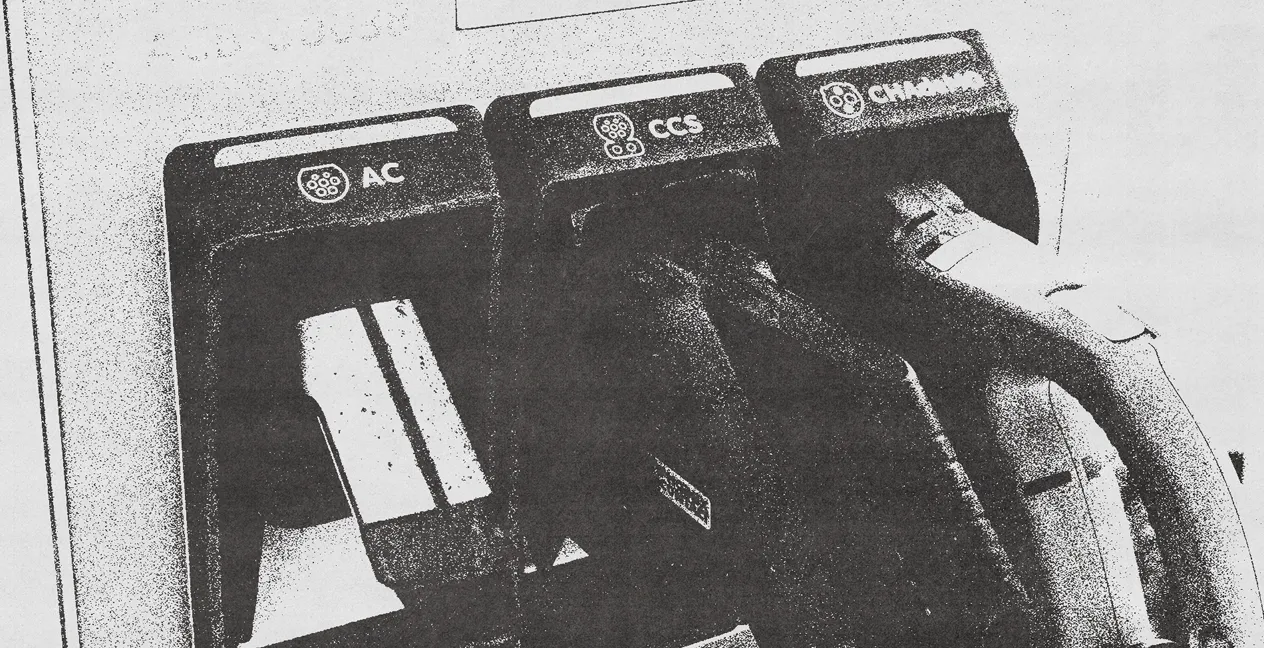
Type 2 — associated with AC charging;
CCS Combo 2 — used for high-power DC charging.
CCS Combo 2 adds two dedicated direct-current contacts to the configuration used by the Type 2 system.
Before using a charging point, drivers should always check which connectors are supported by their vehicle and which ones are available at the charging station.
Why might a 150 kW charger not charge the car at 150 kW?
A common mistake is assuming that the power displayed on a charging point automatically corresponds to the power the vehicle will receive.
That is not the case.
If a charging point can provide up to 150 kW but the vehicle can accept a maximum of 100 kW DC, the car will not be able to use the full 150 kW available.
MOBI.E recommends that drivers know the charging capacity of their vehicle and choose a charging point with an appropriate power output. The organisation also points out that using a charger with a higher power output than the vehicle can accept will not make charging faster.
The same principle applies to AC charging.
If a wallbox can provide 22 kW but the electric car is limited to 11 kW AC, it will continue to charge only up to the maximum power supported by the vehicle.
The power stated on the charging equipment therefore represents what the charger can provide, rather than a guarantee of how much power the vehicle will receive.
Is charging power always constant?
No.
The maximum charging power stated by an electric car manufacturer does not necessarily mean that this value will be maintained throughout the entire charging session.
Charging time and charging behaviour can be influenced by the size and state of charge of the battery, the characteristics of the vehicle's power electronics, the output of the charging point and even thermal conditions. MOBI.E identifies these among the factors that influence the actual time required to charge.
As a result, two vehicles with the same stated maximum charging power may behave differently during a charging session.
This is why the maximum kW figure is important, but it does not tell the whole story.
And with a wallbox: is charging AC or DC?
The domestic wallboxes discussed throughout this guide operate using alternating current.
This is the case with the V2C solutions available from Benecar. The V2C Trydan uses Type 2 and is available in a single-phase 230 V configuration with up to 7.4 kW or a three-phase 400 V configuration with up to 22 kW. The current can be configured between 6 and 32 amps.
The V2C Trydan Pro is also available in single-phase 230 V and 7.4 kW and three-phase 400 V and 22 kW versions, with Type 2 available as the connection to the vehicle.
Benecar is the official V2C representative in Portugal, making both solutions available through its online store, regardless of whether the customer purchased their vehicle from Benecar.
Important note: Benecar exclusively sells the equipment. Installation or fitting services are not included. Installation must be arranged by the buyer and carried out by a specialised and duly qualified technician, in accordance with the characteristics of the electrical installation, the manufacturer's instructions and all applicable regulations.
AC or DC charging: which should I use?
Neither solution completely replaces the other. AC and DC charging serve different and complementary purposes.
AC charging makes particular sense when the vehicle remains parked for several hours. This is the typical scenario in a home garage, at a workplace or in some car parks. Domestic wallboxes can operate at up to 22 kW, depending on the equipment, electrical installation and vehicle capabilities.
DC charging becomes particularly relevant when less time is available and there is a need to recover driving range quickly.
In practical terms:
AC charging
Widely used at home and in the workplace;
Used by the wallboxes discussed in this guide;
The AC-to-DC conversion is carried out by the onboard charger;
Charging power is limited by the vehicle's AC charging capability;
Type 2 is the European reference standard.
DC charging
Mainly used in higher-power charging infrastructure;
Particularly useful during longer journeys;
AC-to-DC conversion is carried out by the charging equipment;
The vehicle's onboard AC charger is not used to perform this conversion;
Generally allows considerably higher charging power;
CCS Combo 2 is the European standard for high-power DC charging.
Rather than always looking for the charging point with the highest kW figure, the most important thing is to choose a solution that suits the vehicle, the time available and the amount of energy that needs to be recovered.
How can I find out how fast my car charges on AC and DC?
The safest way is to check the technical specifications provided by the vehicle manufacturer.
Look specifically for two separate figures:
Maximum AC charging power;
Maximum DC charging power.
Knowing these values makes it easier to understand which wallbox might make sense at home and what charging point power the vehicle can actually take advantage of during a journey.
MOBI.E also recommends that drivers know the charging capabilities of their vehicle and select the charging point power accordingly.
A more powerful charger cannot force an electric car to receive more energy than it was designed to accept.
AC and DC are only part of the charging picture
Understanding the difference between AC and DC helps explain how energy reaches the battery, but there is another important way to distinguish between different charging solutions: the power and charging speed available at different charging points.
This is where terms such as normal, semi-fast, fast and ultra-fast charging come into play.
These classifications should not be directly confused with AC and DC. As we have seen, AC and DC refer to the type of current and the architecture of the charging process, whereas charging speed is related to the available power and the capabilities of the vehicle itself. European classifications even include several power levels within both AC and DC charging.
Ultimately, AC and DC are not competing solutions. They are two different and complementary ways of charging an electric vehicle: one particularly suited to regular everyday charging and the other essential when recovering driving range in a shorter period is the priority.