
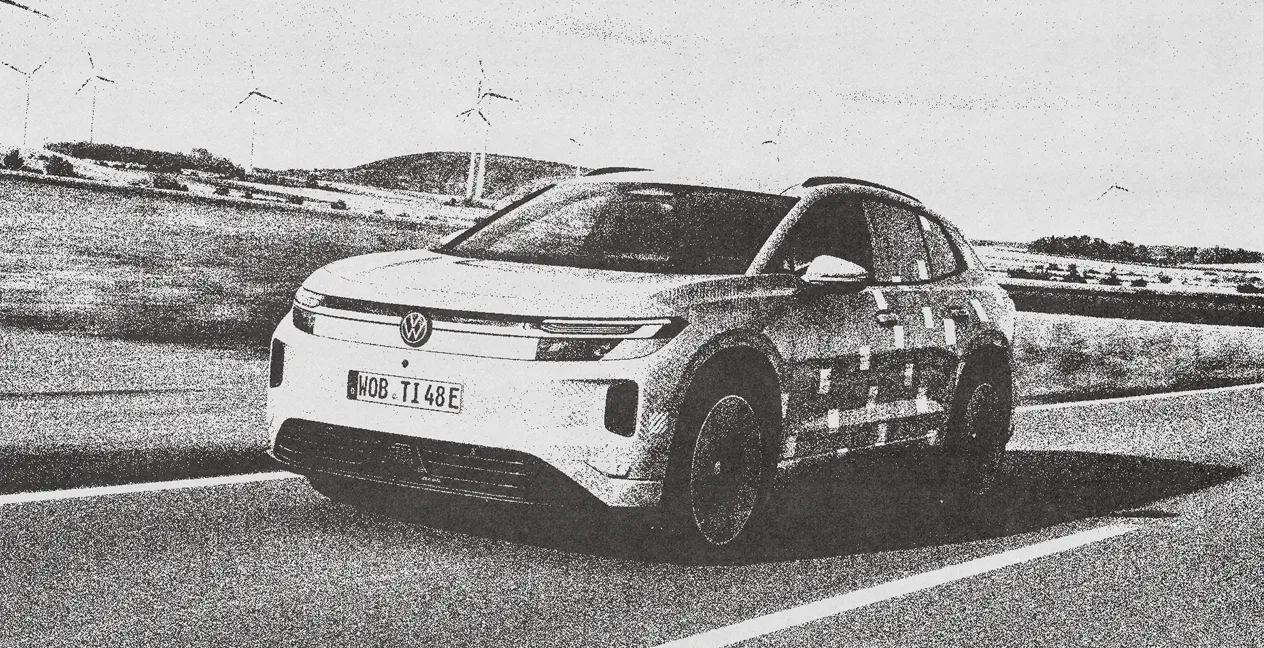
Volkswagen ID. Tiguan arrives in 2027 and succeeds the ID.4 and ID.5
Created by Daniela Ezequiel at Wednesday, 30 September 2026
Volkswagen is preparing an important change to its electric range. The new Volkswagen ID. Tiguan will arrive on the market in 2027 and take the place currently occupied by the ID.4 and ID.5, while also reinforcing an increasingly clear strategy from the brand: using well-known names for its new 100% electric models.
After the ID. Polo and ID. Cross, the ID. Tiguan will be the next step in bringing the electric range closer to Volkswagen’s most recognised names. Despite the arrival of the new electric version, the combustion-engine Tiguan will continue to be sold alongside it.
The new electric SUV will be officially unveiled in October and is expected to adopt a completely redesigned look. Even so, Volkswagen has sought to bring the model closer to the brand’s more traditional visual identity, after several years in which the ID. family followed a very distinctive design language.
Closer to the Tiguan we already know
Although it will continue to be based on an electric architecture, the Volkswagen ID. Tiguan features proportions and visual solutions that are closer to the conventional Tiguan.
According to the available information, it will measure 4.62 metres in length, 1.86 metres in width and 1.62 metres in height, with a wheelbase of 2.77 metres. Compared with the combustion-engine Tiguan, it will be slightly longer and wider, but also a little lower.
At the front, the light signature will play an important role, accompanied by an illuminated Volkswagen logo. At the rear, the three-dimensional taillights, new bumpers and spoiler will help differentiate the model.
Inside, the evolution will also be significant. The ID. Tiguan is expected to feature a 15-inch central display, a 10-inch digital instrument panel for the driver and a third 12-inch screen dedicated to the front passenger. The latter may feature independent Bluetooth connectivity and a privacy mode.
Volkswagen also appears keen to restore more intuitive usability following criticism of the exclusively touch-sensitive controls used in some ID. family models. Among the planned changes will be the return of some physical controls.
Up to 600 km of range
The new Volkswagen ID. Tiguan will continue to use the MEB platform, already known from models such as the ID.4, but is expected to benefit from several technical improvements.
The entry-level Pure version is expected to use a 58 kWh battery paired with a 188 hp motor, offering an estimated range of around 450 km.
Above this version will be the ID. Tiguan Pro, with a 77 kWh battery, 282 hp and a range that could reach 600 km. The Pro 4Motion version, with all-wheel drive and 295 hp, is expected to offer around 560 km of range.
For fast charging, the 58 kWh battery is expected to support a maximum power of 105 kW, allowing it to charge from 10% to 80% in around 26 minutes. The 77 kWh battery could charge at up to 165 kW and should complete the same operation in approximately 29 minutes.
The onboard charger will be rated at 11 kW and all versions are expected to feature V2L functionality, allowing the energy stored in the battery to be used to power external electrical equipment.
Despite the changes in design and positioning, the ID. Tiguan is expected to maintain a close technical relationship with the current ID.4, including the possibility of rear-wheel-drive or all-wheel-drive versions.
Some details remain to be confirmed, including the final luggage compartment capacity and the possible inclusion of a frunk, or front luggage compartment. Volkswagen has also not yet clarified all the details regarding how the ID. Tiguan will replace the ID.5, although sources indicate that the new model will occupy the space currently held by both electric SUVs.
Scheduled to arrive in early 2027, the Volkswagen ID. Tiguan represents more than a simple replacement for the ID.4 and ID.5. It is also another sign of Volkswagen’s new strategy for electric cars, seeking to combine technology and efficiency with names and design elements that are already familiar to customers.
Sources: Notícias ao Minuto, Turbo, SAPO