
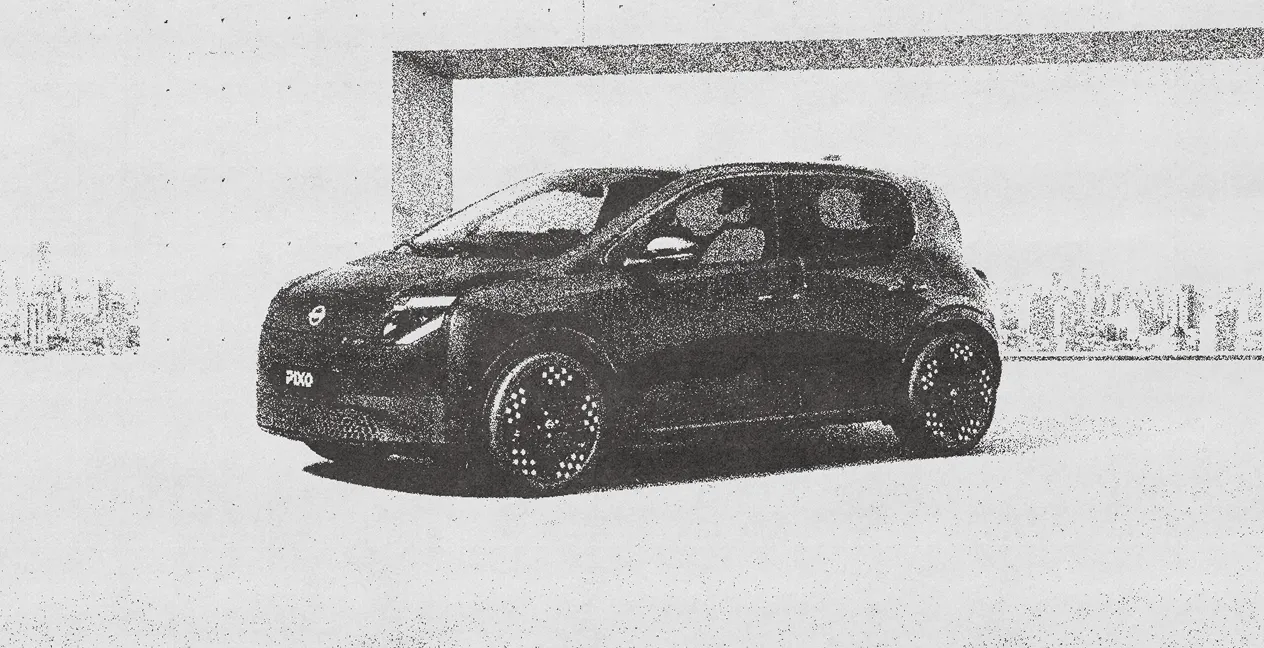
Nissan Pixo returns as an electric car with up to 259 km of range
Created by Daniela Ezequiel at Tuesday, 29 September 2026
The Pixo name is returning to the Nissan range, but this time with a completely different approach. The new Nissan Pixo will be a 100% electric city car, developed especially for the European market and designed primarily for urban use.
With compact dimensions, up to 259 km of range and a strong focus on technology, the new model is expected to reach its first European customers in early 2027.
The Nissan Pixo uses the same technical platform as the electric Renault Twingo and will be produced in Novo Mesto, Slovenia. This sharing of platforms and components makes it possible to benefit from economies of scale and contribute to making small electric cars more affordable.
Up to 259 km of range and fast charging as standard
One of the main highlights of the new Nissan Pixo is its 27.5 kWh LFP battery, the first of its kind to be used in a Nissan sold in Europe.
The announced maximum range is 259 km according to the WLTP cycle, a figure designed primarily for everyday journeys in urban and suburban environments. As with any electric vehicle, real-world range may vary depending on factors such as temperature, speed, climate control use and driving style.
50 kW DC fast charging will be standard across the range and will allow the battery to charge from 15% to 80% in approximately 28 minutes. Using alternating current, the Nissan Pixo will be able to charge at up to 11 kW.
The electric powertrain develops 60 kW, equivalent to 82 hp, and 175 Nm of torque, transmitted to the front wheels. The model will also feature e-Pedal technology, which allows the car to accelerate, decelerate and come to a stop using primarily the accelerator pedal, a feature particularly useful in urban traffic.
At just 3.796 metres long and 1.790 metres wide, the Nissan Pixo was designed to make it easier to navigate narrower streets and manoeuvre in tight spaces. A turning diameter of 9.9 metres further reinforces its urban character.
Despite its compact exterior dimensions, the cabin has been designed to accommodate up to four adults. The rear seats are individual and sliding, allowing the available space for passengers or luggage to be adjusted as needed.
The luggage compartment offers 356 litres of capacity and includes a 50-litre compartment for charging cables. With the rear seats folded down, the volume can increase to 1,221 litres.
Google built-in, Gemini and facial recognition
Technology also plays an important role in the new Nissan Pixo. The model will feature Google built-in, allowing navigation, route planning and other digital services to be used directly through the car’s system.
Another new feature will be the integration of the Gemini assistant, which will make it possible to control different functions related to navigation, communication and entertainment using more natural voice commands.
The Pixo will also feature Face ID facial recognition, capable of identifying the driver and automatically restoring their personalised settings. The MyNissan app will also allow some vehicle functions, including charging, to be managed remotely.
Inside, the driver will have access to a 7-inch digital instrument panel and a 10-inch central touchscreen for the infotainment system.
Visually, Nissan has sought to give the Pixo its own identity despite its technical similarities with the Renault Twingo. The pixel-inspired light signature is one of its most distinctive elements, accompanied by compact shapes and various graphic details throughout the exterior and cabin.
Among these elements are 23 small details hidden around the car. The number was chosen because of the phonetic association between 2 and 3 in Japanese and the Nissan name. The range will also feature colours such as Wonder Purple and Gear Blue, reinforcing the model’s youthful and urban positioning.
The new Nissan Pixo will be produced at the Novo Mesto factory in Slovenia and becomes part of Nissan’s electrification strategy in Europe, alongside other electric models from the brand, such as the LEAF and MICRA.
The first deliveries are scheduled for early 2027. Prices and final specifications for Portugal have not yet been announced by Nissan.
Sources: Guia do Automóvel, Turbo, Razão Automóvel