
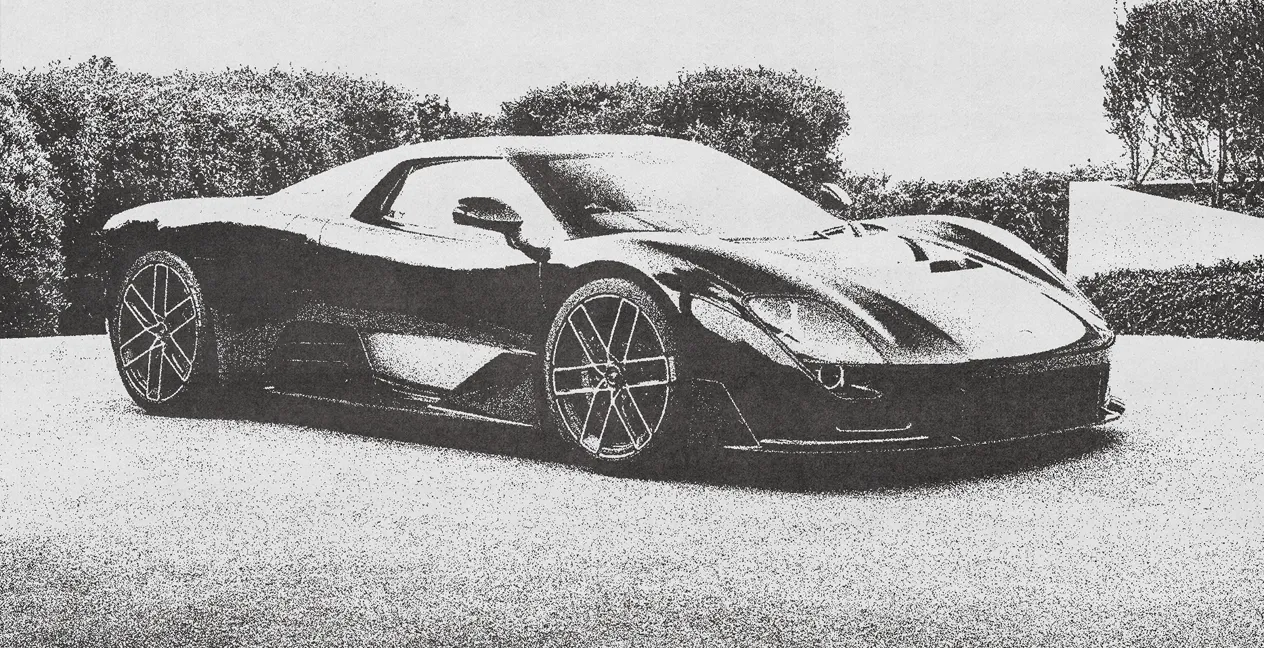
McLaren McL 6GT revives the M6GT and returns to a pure manual gearbox
Created by Daniela Ezequiel at Tuesday, 25 August 2026
McLaren has decided to look to the past to imagine one of its next supercars. The result is the McLaren McL 6GT, a model that revives the spirit of Bruce McLaren’s historic M6GT and brings back a feature that has not been part of the brand’s road cars for more than three decades: the manual gearbox.
Presented during Monterey Car Week in California, the McL 6GT previews a new production model scheduled for 2028. The concept combines an all-carbon-fibre construction, a V8 engine, rear-wheel drive, and an approach clearly focused on the connection between driver and car.
More than a simple design exercise, this concept is expected to form the basis of a highly exclusive supercar, produced in limited numbers and positioned above McLaren’s current range.
A dream that began with Bruce McLaren
To understand the McL 6GT, it is necessary to go back to the late 1960s.
After the experience gained with the M6A in Can-Am competition, Bruce McLaren wanted to apply some of those principles to a road car. The aim was to create an extremely light, low, and fast supercar, while still making it sufficiently usable in everyday life.
Bruce even personally used an M6GT for trips to the factory and to races. The project also had a competitive side, with plans to develop a version for the Group 4 category and the 24 Hours of Le Mans. At the time, 50 examples would have been required to obtain homologation.
Development, however, was interrupted following the death of Bruce McLaren in June 1970 during testing at the Goodwood circuit. The M6GT project never had the opportunity to evolve into the production run that had originally been planned.
Only a few examples were built. McLaren produced one for Bruce, while Trojan built two more chassis. The M6GT used a 5.7-litre Chevrolet V8 engine prepared by Bartz, producing 375 hp and paired with a five-speed manual gearbox.
Although the McLaren F1 did not arrive until 1992, the brand itself considers the M6GT to be its first road car. The two models share a similar philosophy, based on low weight, driver involvement, and the transfer of competition-derived solutions to road use.
Almost six decades later, the McL 6GT revives precisely that idea.
The manual gearbox takes centre stage again
One of the biggest new features of the McLaren McL 6GT is right at the centre of the cabin.
The model brings back a six-speed manual gearbox and becomes the first McLaren road car with three pedals and a traditional gear lever since the legendary F1, launched in 1992.
It is a particularly unusual choice in a segment where dual-clutch automatic transmissions and electrified powertrains have become dominant.
McLaren is looking to follow a different direction. The aim is to recover a more mechanical and engaging driving experience, with hydraulic power steering, physical controls, and more direct interaction between driver and car.
Even the gear lever has received special attention. Its design aims to provide greater feedback during gear changes and includes a three-dimensional representation of the Speedy Kiwi, one of the historic symbols associated with McLaren and the New Zealand origins of the brand’s founder.
The mechanical philosophy continues with the engine. The McL 6GT uses a V8 connected exclusively to the rear wheels, while the monocoque structure and bodywork make extensive use of carbon fibre to increase rigidity and keep weight down.
One of the sources also states that it is a twin-turbo V8 powered purely by combustion, without a heavy electrification system, reinforcing the focus on lightness and more direct response.
Visually, there are also several references to the past. The McL 6GT revives proportions inspired by 1960s racing prototypes, but adapts them to current aerodynamic requirements.
The roof extends over the engine cover to create a continuous silhouette, while the so-called Racing Loop brings back visual elements from the original M6GT. Bruce McLaren’s signature also appears in the engine compartment, accompanied by other historical references to the 1969 project.
Inside, carbon fibre, machined aluminium, and physical controls help maintain this combination of past and present. Technology is still present, but without eliminating the tactile and mechanical character that McLaren intends to recover with this new project.
The McLaren McL 6GT therefore acts as a bridge between two eras. On one hand, it revives one of Bruce McLaren’s most personal projects. On the other, it shows how the brand intends to reinterpret that philosophy almost 60 years later, using modern materials and engineering.
The version presented in Monterey is still a concept close to production, but McLaren has already confirmed that it will form the basis of a new highly exclusive model, scheduled to arrive in 2028 and intended for a very limited number of customers.
At a time when performance and technology are increasingly associated with electrification and automation, McLaren is also preparing to follow another path: a V8, rear-wheel drive, low weight, and a manual gearbox.
Almost six decades after the original M6GT, Bruce McLaren’s dream is taking shape once again.
Sources: AutoSport, Auto DRIVE, Motor24