
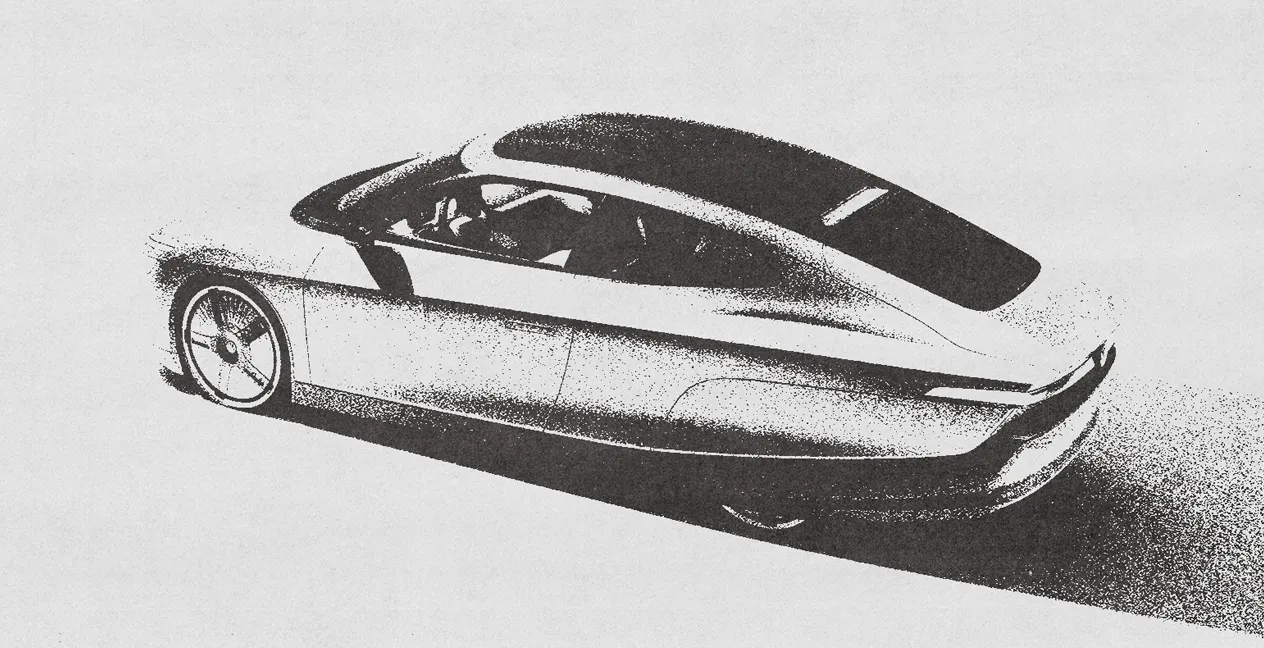
Volkswagen creates the world’s most efficient electric car
Created by Daniela Ezequiel at Wednesday, 16 September 2026
Volkswagen has unveiled the Mission Efficiency, an electric prototype created to demonstrate how far efficiency can be pushed when aerodynamics, weight, tyres and the propulsion system are all developed with the same objective.
And the figures are impressive. The Volkswagen Mission Efficiency has a drag coefficient of just 0.158 and managed to travel 1,278.36 kilometres on a real-world journey between Wolfsburg, Germany, and Vienna, Austria, requiring only one charging stop. At the destination, it still showed an estimated remaining range of 164 kilometres.
Rather than directly previewing a new production model, this prototype works as a true laboratory on wheels, showing what Volkswagen can achieve using, to a large extent, technology that is already prepared to reach its next electric cars.
Three records for the Volkswagen Mission Efficiency
One of the main highlights of the Mission Efficiency is its aerodynamics. The prototype has a drag coefficient of just 0.158, an extremely low figure for a road-legal car.
The body was designed with a shape inspired by a water droplet, while the frontal area is just 2.08 square metres. To reduce air resistance even further, Volkswagen used solutions such as active shutters to control cooling, an almost completely enclosed underbody, flush-mounted door handles, frameless windows and partially covered rear wheels.
The work carried out allows the Mission Efficiency to consume more than 30 percent less energy than the Volkswagen ID. Polo at speeds above 80 km/h. According to the brand, at 140 km/h the prototype requires approximately the same amount of energy as a conventional ID. Polo travelling at 100 km/h.
But efficiency was not limited to the wind tunnel.
On a journey carried out under ideal conditions, at a constant speed of 68 km/h, with no uphill sections and auxiliary systems such as the air conditioning switched off, consumption was just 6.48 kWh/100 km.
In an officially documented real-world test, the Mission Efficiency covered 1,278.36 kilometres between Wolfsburg and Vienna, travelling through Poland and the Czech Republic. Average consumption was 7.51 kWh/100 km including charging losses, or 6.89 kWh/100 km without those losses.
Average speed during the journey was 67.72 km/h, while the maximum speed reached 138 km/h.
Technology from the future ID. Polo
Despite its futuristic appearance, the Mission Efficiency does not rely exclusively on experimental technology.
The electric motor installed on the front axle is derived from the unit that will be used in the Volkswagen ID. Polo. It develops 99 kW, equivalent to 135 hp, and 264 Nm of torque, and is paired with the front-wheel-drive MEB+ platform.
The battery has a usable capacity of 54.9 kWh and can be charged at up to 11 kW using alternating current and 105 kW using direct current.
This use of components close to production is precisely one of the central ideas behind the project. Volkswagen aims to demonstrate that achieving high levels of efficiency does not necessarily have to depend on extremely expensive technologies or solutions intended only for cars produced in small numbers.
The same propulsion architecture is expected to be used in models such as the ID. Polo and ID. Cross.
The brand also worked with Continental to develop specific tyres based on the EcoContact 7. These have a rolling resistance of 4.9 kg per tonne, approximately 25 percent below the limit required to achieve class A under the European tyre labelling system.
Even the braking system was designed to reduce energy losses. The rear axle debuts an electromechanical solution that helps reduce friction losses and optimise the distribution of braking force and energy recovery.
Solar energy and an interior designed to save weight
Another of the more unusual solutions can be found on the roof and tailgate.
The glass panels integrate a 370 W photovoltaic system capable of supplying energy to the vehicle’s onboard electrical systems. Depending on weather conditions, location and time of year, Volkswagen estimates that this technology could contribute up to 30 additional kilometres of real-world range per day.
The efficiency principle continues inside the cabin.
Instead of installing heavy equipment that is not always used, Volkswagen opted for a minimalist approach. Some infotainment, navigation and multimedia functions can be handled by the occupants’ smartphone or tablet, while a conventional sound system is replaced by a portable Bluetooth speaker.
The construction also combines an aluminium monocoque structure with components made from carbon-fibre-reinforced polymer and aramid composite, aiming to reduce weight without compromising structural rigidity.
Despite all this focus on efficiency, the Mission Efficiency still takes everyday usability into account. It measures 4.775 metres in length, has a 2+2 configuration and offers a luggage compartment with 481 litres of capacity. The rear seats, however, were designed mainly for passengers up to around 1.60 metres tall.
The Mission Efficiency does not mean that a Volkswagen with these characteristics is about to arrive at dealerships. The project should be seen primarily as a technological demonstration and a way of testing how far the brand’s efficiency solutions can go.
Even so, there is one particularly relevant point: several of the technologies used are already related to components intended for high-volume production models.
At a time when range continues to be one of the main topics associated with electric cars, Volkswagen is showing another way of approaching the problem. Instead of constantly increasing battery capacity and weight, the solution can also involve making every kWh go much further.
Sources: Turbo, Razão Automóvel, Notícias ao Minuto