
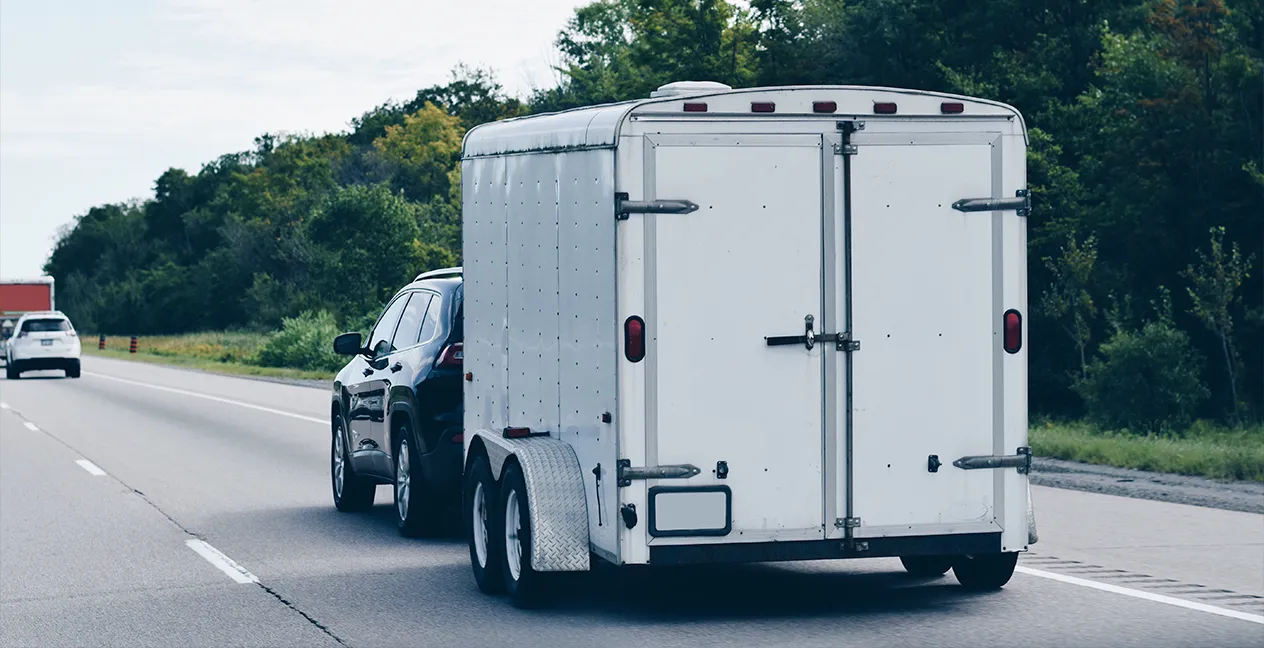
Rules for driving cars with a trailer
Created by Ana Faustino at Tuesday, 17 May 2022
Article updated on October 19, 2026
There are several reasons why you might need to drive a vehicle with a trailer, whether to transport bulkier loads, a caravan, a boat or other items. If you hold a category B driving licence, you should know that under specific conditions you may drive vehicles with a trailer.
Yes, that is correct! Your category B driving licence allows you to drive cars with a trailer if the gross weight of the trailer is up to 750 kg or if the gross weight of the trailer + towing vehicle combination is up to 3,500 kg.
Gross weight is the maximum capacity that a transport vehicle can support, corresponding to the sum of the unladen weight of the vehicle and its payload capacity.
If the gross weight of the combination is between 3,500 kg and 4,250 kg, the driving licence required will be for light vehicles with a trailer, i.e. category B+E. To obtain this category, if you already hold a light vehicle licence, you do not need to take a theory test. You must apply for a learner’s permit directly from the Regional Directorates and District Delegations of the IMT, and the practical test may be taken at the IMT, I.P. or at private examination centres.
Regarding the gross weight of the trailer:
Up to 300 kg – it does not require its own registration plate. However, if it covers the vehicle’s plate, a registration plate must be fitted to the trailer;
Over 300 kg – it requires its own registration plate, vehicle registration document and insurance;
Between 750 and 3,500 kg – it also requires a mandatory periodic inspection. The first inspection must take place 2 years after registration is assigned and then annually.
Regarding the trailer lights:
1 registration plate light;
2 red position lights;
2 red brake lights, if those of the vehicle are not completely visible;
Direction indicator lights;
Fog light, if the trailer was registered after 1990;
2 red triangular reflectors;
Non-triangular amber reflectors on the sides, if the trailer dates from after 1994;
13-pin electrical connector allowing the use of a reversing light.
Trailer approval is national, so if you are travelling abroad you will need to check whether your trailer’s approval is also valid in those countries. Fortunately, several brands have trailers that are legal to drive in multiple countries.
Also pay attention to the speed limits:
In built-up areas: 50 km/h
Other public roads: 70 km/h
Roads reserved for cars and motorcycles: 80 km/h
Motorways: 100 km/h
Source: ACP